YouTube Journey, Academy & Tips

I wrote this blog post in 2019 and thought I would post it here. There have been some changes to my YouTube account since I have written this blog post but most of what I have written about still applies today. Today I am focusing on YouTube’s new “shorts” format but I will go into that in another post.

I’ve been uploading clips to my YouTube account since its inception in 2005. In the beginning, I didn’t think much of it other than a place to store and share my videos as back then, one had to upload a video to their own server to share it – and what a huge pain in the ass that was. It was a cumbersome process and not convenient in the slightest. YouTube’s arrival was a huge relief for multimedia producers like myself. So, I uploaded a variety of clips from stand alone candid clips to short composed videos. To date, I have obtained a 92% like rate on 4,692,855 views (6,193,022 in 2023) on my clips – not too shabby for someone who neglected their account for several years. Early on, one of my videos got picked up by the Ellen Degeneres Show and several other clips were discovered and licensed by TV shows. But more than that, it’s been a place where interesting conversations have unfolded in the most unexpected way, and it is why I am returning to it today.

In 2016, I completed myย MA research analyzing YouTube commentsย of one of my popular videos where I learned that videos positive in nature (with a genuine surprise element) are most liked, shared and have higher chances of going viral than negative ones. By todays standard (2019), the video is viral (4 million views and climbing over 12 years – 5.5 million in 2023) but in most recent years, more videos have gained momentum more quickly than they did back in the day – due to the platforms massive growing viewership. And so my one clip (of an orca and a dog interacting) continues to climb in views, likes, shares and comments, and it was here where I did my research. I have a few other clips that are doing well but are not viral in the same sense of the first one. A couple of years have passed since doing my Masters and this year I have seriously aligned my attention with the YouTube platform for the first time.

For many years, I ignored my YouTube account completely. What I mean is that I purposely didn’t look at it. Why? Due to an anxiety condition to be honest. Sounds silly right? Well, my one viral video was connected to a bigger story in my life – that of a famous orca named Luna, who I worked with in 2003. The story became world famous and was highly contentious. Because I had been involved, I got stuck right in the middle of it all and it caused me quite a bit of stress. Quite frankly, I didn’t want to look at any of it. Back then the Internet was not as rampant with lynch mobbing and cyber attacks. Today, cyber bullying has caused people to commit suicide and the problem seems to be only getting worse. One just has to do a quick search on the topic to find the pages of evidence. It has become a very concerning situation. And as for me? I didn’t want to see the growing attention of my video(s) but I intuitively knew to leave my work up and that maybe one day I’ll come around.

Over the years I continued to feed the machine as to speak, but not spending too much time on my channel – so upload and ignore. I did add titles and keywords but they were minimal at best, but again back in the day, YouTube wasn’t a viral platform as it has become today. Other than looking at other unrelated content (which I did much of), I ignored my own. That is until now. It is now 2019 and it’s a new year. 2018 was a rough year where I faced some big health obstacles (requiring a couple of hospitalizations; surgeries and organs removed) and with that behind me, my anxieties have dimmed. This has given me a new opportunity to look into things that I had previously ignored or forgotten about. For instance, I used to be an experimental (16mm) filmmaker back in the 90’s and I loved it. My work was screened in festivals, on TV and I was even given an award by the Victoria Film Festival. Enter the 2000’s, and I swapped my passion for filmmaking with that of creating websites – especially with Flash. I got sucked down the Internet rabbit hole and really never came back to filmmaking again. Although after that, I spent a lot of time documenting through video, and that’s where my YouTube channel comes into existence.

I am now revisiting the idea of video making with a new born interest in YouTube. Once better, I decided I would invest in a vlogging microphone that attached to my iPhone and continue to explore with video making. Back when I started out, we used huge clunky 16mm film and (various format) video cameras. It was a very heavy experience but we pulled it off. Today, we have film making machines in the palm of our hands, how convenient is that! I can no longer resist, and so I am returning to these roots. But before I get in too deep, I feel compelled to truly understand YouTube and all of its super powers so that I can truly harness it. In recent years, people have made a living from their YouTube channels and have even become world famous. I am not in this for fame but I would love nothing more than to make it a profession on some level and also help other people with their YouTube endeavours. There is no better way to do this than to study with the YouTube Academy and it’s probably the best thing I have done since doing my Masters.

I have just completed 7 core courses over the past month, and applied my learning in realtime – transforming my dormant account into a living and breathing reflection of myself. I have spent countless hours revising the metadata on 296 videos (and still am repairing videos) which includes correcting titles to reflect better analytic search results, beefing up keywords and creating custom thumbnails for each and every video (a very labour intensive task). I am not finished however I have revised my most viewed videos and am working backwards so that I may breath life into those videos that have been forgotten about. I am fishing clips out of my archive to build new found themes and stories for viewers through my playlists and sections.

As a result, I have become a YouTube analytics junkie – kind of ironic knowing where I started. It really is a worthwhile place to spend some time in order to fully understand where your account is at and how to grow it. I will continue to learn through the Academy as there are more courses I’d like to take but they take some time. I do not recommend flying through them, rather learning with realtime content and applying each and every exercise given, as it helps to transform and build your channel in the best possible way.

To date here are the courses I have completed:

  • After your shoot
  • Before your shoot
  • Building a Global Channel
  • Copyright on YouTube
  • During your shoot
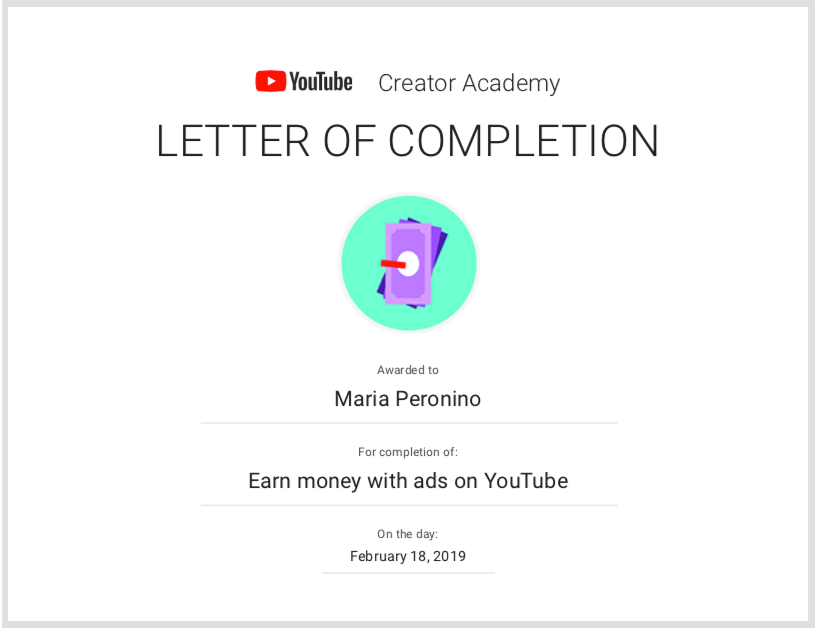
  • Earn money with ads on Youtube
  • Get discovered
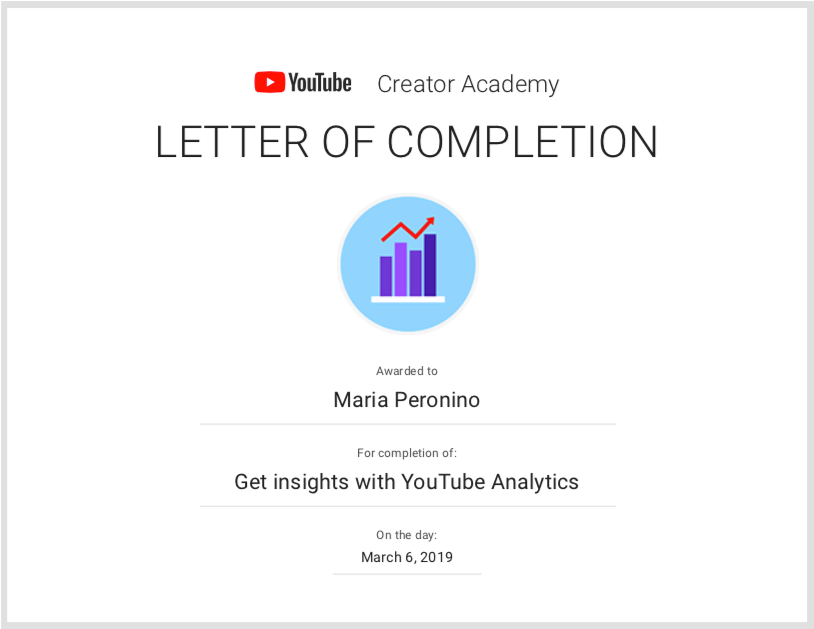
  • Get insights with YouTube Analytics
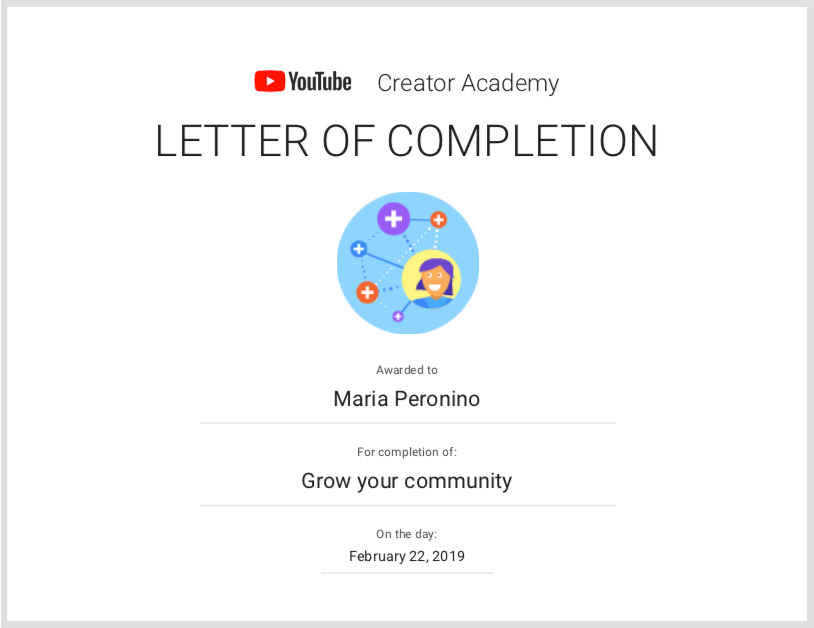
  • Grow your community
  • Hook them with your channel trailer
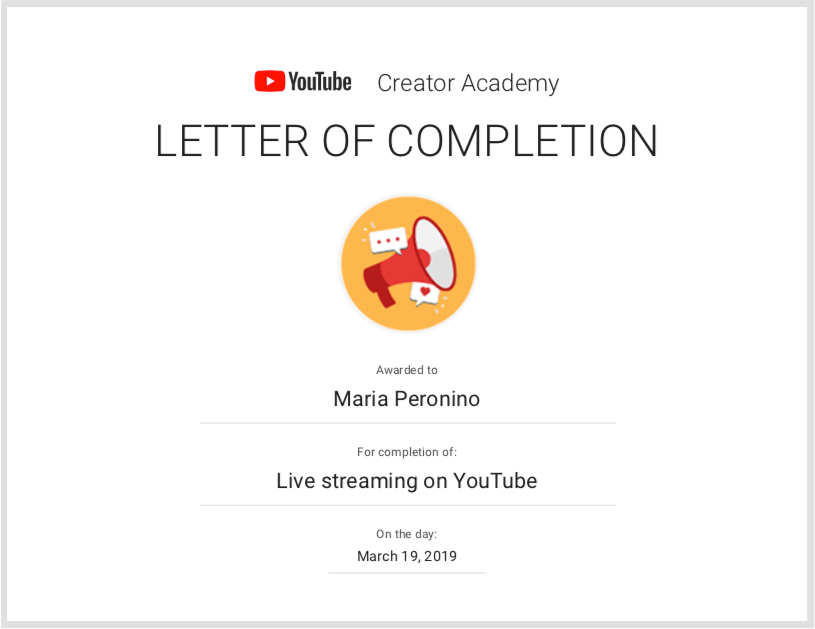
  • Live streaming on YouTube
  • Platform overview
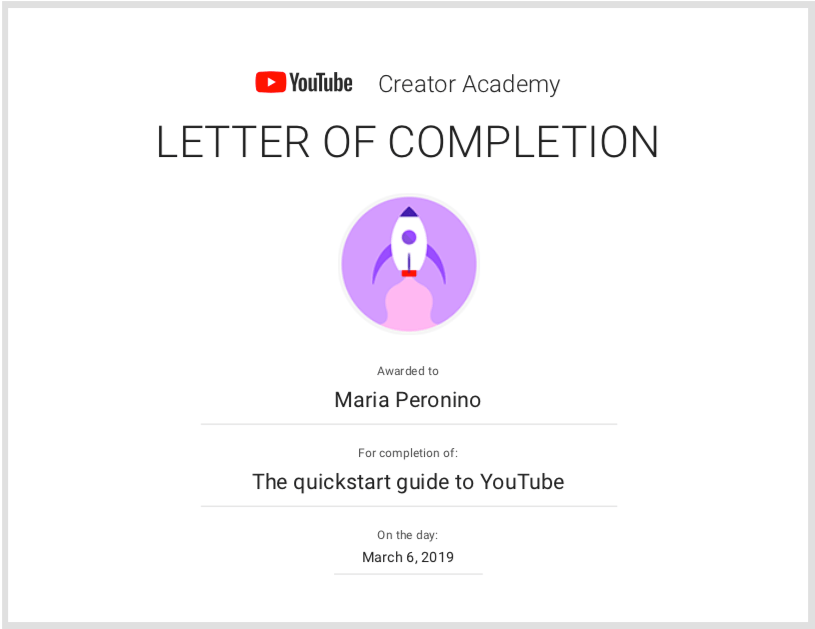
  • The quickstart guide to YouTube

I will continue to work my way through other courses but I started with the ones I felt were most useful in helping me to get a grip of my current channel and the pile of content I have dumped there. This is also helping me to make decisions on how to direct my future content, by examining my audience through analytics. There is a kind of science involved in this.

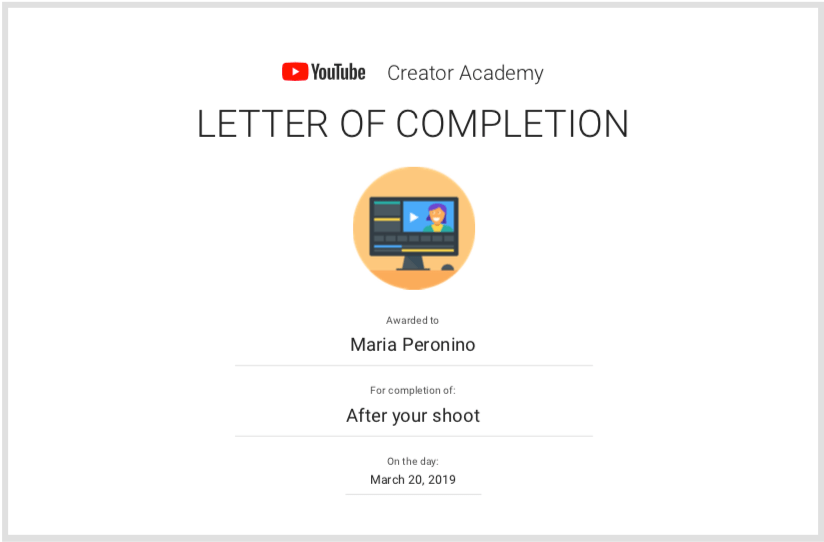
With all this said, I feel confident in declaring myself as a YouTube specialist. I will continue to grow this endeavour mindfully with my attention invested on past and future content. I am also capable of helping others with their YouTube endeavours. I now fully understand some of the key components of getting a YouTube channel seen and growing. I have observed many accounts fed with current content but with little to no views. If they just took a few extra steps in shaping their content and channels – it’s best to do it as you go along, as going back over a large volume of content will be time consuming and back breaking. This is why I am undertaking this on a part time schedule. My poor tail bone just cannot take the number of hours required to repair my own channel. Ultimately, all of this has given me the knowledge and experience and can understand how to marry the content with the analytical side of the data. Together with my graphic design skills, I can experiment and transform my content to see what works best.

YouTube Academy is 100% worth the time and energy if you are serious about your YouTube channel. If you don’t have the time and the energy but need assistance for your channel, then you can get in touch with me. There are some critical keys that users need to consider with their channel or it’s really not worth the time at all. I can’t stress this enough; understanding the meta data and analytical side is the most critical to getting this right. I’m constantly amazed at how YouTube continues to grow into what I think is the most powerful platform on the Internet and it promotes a place of creativity, independence and excitement. There is also a reward in all of this, getting paid. Although getting paid is a huge benefit in running a channel, it shouldn’t be what brought you there to begin with. It starts with your passion and if you’re really tied into it, then the rest will follow. As someone who has had a monetized account for several years now and didn’t care about it, I know this first hand. In order to become monetized you need to meet certain criteria first and it’s become harder as of recently. So ultimately it’s really best that you’re driven by your passion and not the money. As YouTube emphasizes over and over in their courses, just keep at it!

My tips for starting out:

  1. Understand your niche(s)
  2. Come up with a branding
  3. Create videos you are passionate about and be yourself
  4. Don’t produce offensive content (stick to community guidelines)
  5. Use proper meta data (titles, keywords, descriptions & thumbnails)
  6. Don’t mislead or spam viewers (including in meta data)
  7. Engage your viewers & ask them to subscribe
  8. Create an upload schedule, let your viewers know about it and stick to it
  9. Understand analytics and utilize it to steer your channel
  10. Use tools such as cards, playlists and sections to group content

Please subscribe to my YouTube channel: https://www.youtube.com/channel/UC5Pjhkm5EbwMN7hFjDQfGMA
Check out YouTube Academy here: https://creatoracademy.youtube.com/page/education

Learning with an Invisible Disability

I have been away for a few months, in Ontario and with Covid for a longer period of time than I anticipated but now I am attempting to get my head back in the game although I’ve been feeling a little cognitively unmotivated lately.

For this post, I have decided to introduce “Seed” as a character to accompany a sensitive and uncomfortable topic for me. If you grew up experiencing difficult learning circumstances in school and in society, then this post might both be a trigger and also a catharsis for you, to not feel isolated in your journey. When I decide to talk about this topic, Seed will be there. Seed is a concept where the seed (creative idea) and the nervous system sensitivity are represented together in a cute image, in order to feel safe.

At a very young age, I was diagnosed with a highly sensitive nervous system or HSP (today classified under neurodiverse) and was easily startled by noise. My life-long struggle with sleep began as a toddler and was prescribed (by a doctor) caffeine to fall asleep – this doesn’t work for me as an adult though lol. By the time I reached daycare, I endured a head trauma when an older child threw a brick at my head when I was playing alone in a sandbox, resulting in a rush to the ER for stitches. Further along in elementary school, in order to reduce distraction, a cardboard box was placed around my desk while situated next to the teachers desk, producing a humiliating spectacle in front of my peers. Additionally, I was placed in the special education class as I had difficulty learning. I experienced tremendous anxiety when it came time to reading out loud in class. The teacher would randomly select a student to read and I did everything I could to disappear from being selected. When I would read out loud, I found that I experienced some kind of cognitive delay between reading and speaking and this was traumatic for me causing me to gap and stutter. Even today, I find my eyes can jump around the page. I failed grade 2 and lacked the support around me to nurture my unique learning needs. Additionally, I was bullied at times by other groups of classmates who clearly saw me as an easy target. By the time I reached high school, I had learned how to better blend in, although I moved around often so I didn’t have long before relocating. During grade 11 English class, a girl took my essay prior to handing it in, and read it out loud to the class while laughing out loud, her laugh is forever embedded in my memory. You can already guess that what I wrote wasn’t supposed to be funny but after the fact I realized my writing was so bad that it was accidentally comical. I remember laughing along because her laugh was contagious. I don’t remember being offended just taking note of the event. I forgave her.

To say I was relieved that school was over, was an understatement. I managed to graduate and with decent marks, who knew! Now don’t get me wrong, I actually love learning and have found throughout my adult life that it’s one of my biggest passions. I soon realized after high school that I was destined to take the creative path so I went on to study a BA in Image Arts. I created films that were screened in film festivals and even nominated for awards. After that I enjoyed steady years of creativity while working as a digital designer. I think this is the time in my life where I actually thrived – between my 20s and 30s. In my 40s, I went on to study a MA in Communication and Technology however once again, found myself experiencing some of the obstacles that followed me throughout my childhood. I hired a tutor early on to help establish a proper writing style and confidence. During our in-person residency, I found myself often needing to sit to the side of the class while wearing a hat and sometimes sunglasses as I was so sensitive to the fluorescent lights that I couldn’t concentrate – this created a familiar feeling of humiliation and alienation I felt as a child. During my final in-person residency, I fell ill with N1H1 and struggled to recover to the point that I threatened to quit but was granted an exception with flexibility. My Masters took me 4 years to complete even though I wasn’t doing anything other than part-time design work at the time. I found myself extremely exhausted by the mental tasks of reading mountains of peer-reviewed articles and endless computer screen exposure. I suppose it was no surprise that by the time it was over – yes I finally graduated – I had reached complete burnout, and was diagnosed with a large tumour that resulted in major surgery. Since then, my life has been forever changed.

Realizing I had succumbed to a complete physical breakdown, a life riddled with insomnia, anxiety, IBS, scoliosis, vertigo, and a myriad of other health problems, I had come to terms that I was not able to adapt my body to the world out there and I was going to have to figure out how to find my way. I have spent half a decade practicing and learning stress-relieving healing arts therapies (eco therapy, reflexology, art therapy) as a means of coping and are now built into my daily routine. Ultimately, it is my creativity that has saved me from self-destruction. Without it, I am not sure how I would be coping today. Miraculously, I have not fallen to substance abuse or any other kind of self-destructive habit and I don’t judge others who have. However, I still continue to live with anxiety and uncertainty. I am learning that gratitude is my biggest ally.

Now, in my 50’s, I am taking inventory of my life and looking at the bigger picture. Why has my life been so challenging? Why have I struggled? Why did and why do people treat me differently? Why are some people mentally abusive towards me? What do I need to know about myself so that I can achieve peace and stability in my life? Tired of hiding, masking and pretending, I started to do some online research and found that my life experience is very similar to those who are autistic. It turns out, all of my diagnosed health problems and sensitivities, fall under the umbrella of autism. As it is a spectrum, each person can have different symptoms but we are bound by a few hallmark ones; sensory overload is a big one. I experience quite a few characteristics but I wouldn’t say my case is extreme although enough to impede on my ability to thrive in certain ways. In 2005 after I fell ill from another virus that left me with vertigo issues, I went through a battery of tests and an EEG determined I had a cognitive disability. Although I was motivated to understand my vertigo condition at the time, I now realize this disability has always been there. Learning disabilities also fall under the autism spectrum. I took a series of online tests and they all came back the same – my results fell outside of the “normal” range and were pushing their way about 1/4 of the way up through the autism spectrum. It has been recommended I be analyzed for an official diagnosis but with our medical system being so difficult right now, I will wait. What is important for me is understanding who I am, why I am, and how to go forward with better community and support. I also want to make myself visible to others who like me, are struggling to find their place and people in the world.

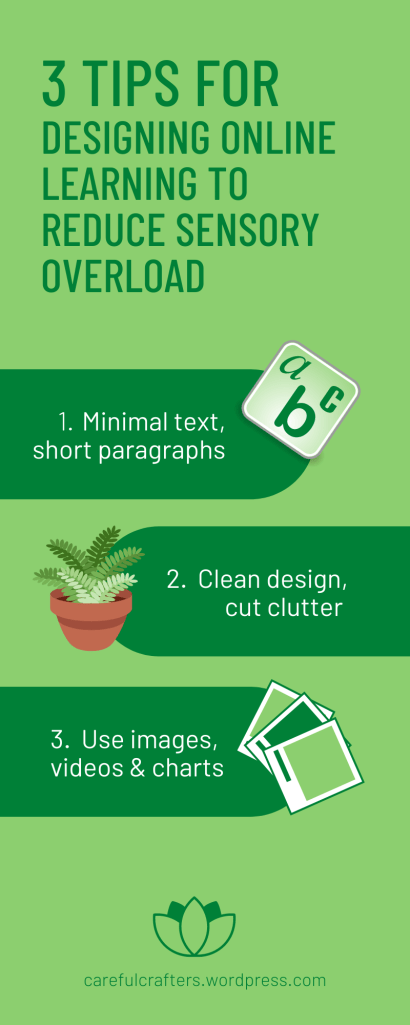
After a long break from both academics and digital creative work, I am back but with a new found appreciation in online learning and content creation. Now, unlike when I was growing up, there is better understanding of how people learn and what is needed to accommodate different types of learners. For instance, I am a visual learner and I learn best by doing. Although I employ all forms of learning, there are types that help me to absorb information better than others. I have new found appreciation and excitement for learning because even though I have struggled with it, it is something I love doing on a daily basis. Learning excites and motivates me to live. I no longer compare myself, feel ashamed, feel I need to hide or pretend that I am like everyone else. I know that I am a talented, creative person who has so much to offer. That is the thing with autism, it also comes with gifts. I don’t see it as a disability rather a difference, I no longer see myself as subordinate, just different. I have come to terms with the fact that I process information differently, always have and that I have been deprived time and time again from the flexibility that I needed to learn by and thrive. I am so relieved that things have changed for the better. Although not diagnosed specifically as autistic, I think learning about autism is probably the missing link I needed to discover, in order to better understand who I am, so I can thrive in ways I have not before.

If you find any errors, don’t hesitate to let me know. I can read and reread and not catch them ๐Ÿ™‚

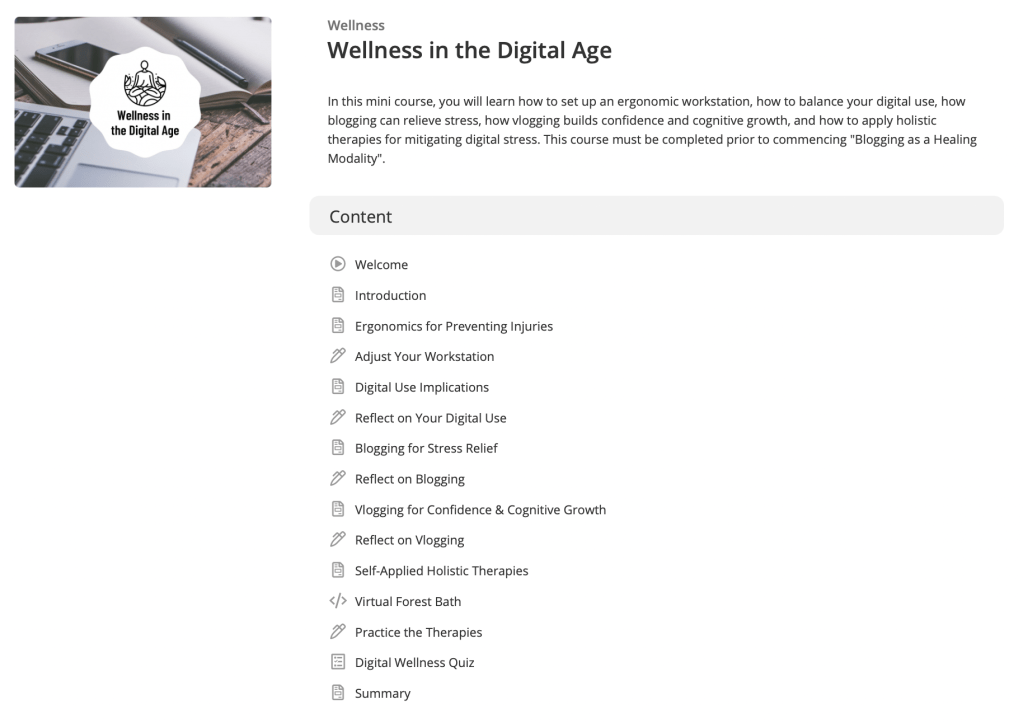
Online Course: Wellness in the Digital Age

logo of the course

Wellness in the Digital Age – A free mini course

This is my first designed self-paced mini-course developed using academic theories and principles while a student at Algonquin College. This is the prerequisite course for Blogging as a Healing Modality (covering WordPress, YouTube, Canva, Pinterest) currently under development. This mini-course can be taken as a stand-alone and is recommended for adopting as a digital stewardship if blogging is of interest to you. Course will take about 2 hours to complete including the readings, videos and activities.

By the end of this mini-course, you should be able to complete the following:

  • Establish body position to prevent occupational injuries while using technology
  • Identify digital use implications to better balance your technology use
  • Explain how blogging can reduce stress through story telling
  • Explain how vlogging can improve cognitive function
  • Apply holistic therapies to relieve tension from technology use

Please note: TalentLMS has removed the free course option and I am no longer able to provide access to this. You can find the course core content below.


Why I made this mini-course

After a series of digital use injuries (back pain, tendonitis, vertigo, eye strain, anxiety), I studied a range of holistic therapies to help bring balance to my digital work. Now, as a certified healing arts practitioner, this mini-course introduces forest bathing, reflexology, reiki and yoga to bring relief to the mind and body to offset the stressors that technology can bring. After practicing these therapies for 5 years, I am now balancing my digital use in a more productive and sustainable way, and I hope to help others do the same.


Introduction

Wellness in the digital age has become paramount as there are concerning mental and physical implications from using technology. Digital use pertains to hardware: computers, mobile phones, iPads/tablets, and the software they support on those devices that involve scrolling, typing, mousing, and texting. Itโ€™s imperative that before you set out on a digital project, that you establish technology stewardship over yourself and utilize holistic tools to counter the negative implications that technology use may have on you. 

Too much of anything will bring about imbalance in the body and so this module supersedes the technology learning modules ahead, so that you can equip yourself with the proper knowledge of keeping yourself safe when using digital technologies. This module will not go into major detail about privacy and ethicality but itโ€™s a good idea to follow some important rules: do not publish your personal phone number, address, social security number or any other pertinent identification on the Internet as this is a risk for identify theft and overall safety of your whereabouts. If you wish to remain completely hidden from search engines then you can keep your work private.

“The medium is the message. This is merely to say that the personal and social consequences of any medium – that is, of any extension of ourselves – result from the new scale that is introduced into our affairs by each extension of ourselves, or by any new technology”. – Marshall McLuhan (Canadian Communication Theorist)

Learning Outcomes

By the end of this course, you should be able to complete the following:

  • Establish body position to prevent occupational injuries while using technology
  • Identify digital use implications to better balance your technology use
  • Explain how blogging can reduce stress through story telling
  • Explain how vlogging can improve cognitive function
  • Apply holistic therapies to relieve tension from technology use

Key Terms or Concepts

Key Terms or ConceptsDefinition
BloggingDigital form of journaling
Digital UseImplications of using technology
ErgonomicsBody position in relationship to using a computer or device
Forest BathingA form of nature therapy
ReflexologyAncient practice of applying pressure to reflexes
ReikiJapanese form of energy healing
VloggingVideo form of blogging

Reviewing The Workstation

As we use digital technology, we often forget about the impacts our body endures in the process. Proper positioning of the body in relationship to technology will prevent injuries to eyes, neck, arm, hand, wrist and spine. 

Recommended adjustments:

  • your monitor needs to be an arms length away
  • wrists straight when using keyboard and mouse
  • hands at or below elbow level
  • chair height so knees are about level with hips

Read the following WikiHow article and observe the images for cues on how to set up your workstation: How to Set Up an Ergonomically Correct Workstation

Watch video (3:01): 9 Tips for a Healthy Ergonomic Workstation – Mayo Clinic

Adjust Your Workstation

Activity: Adjust or prepare your workstation as recommended in video and article. If you do not have access to a traditional desk and chair, please refer to the adjustments I have made for working with a laptop at a kitchen table with a regular chair. See this image

Consider:

  • lumbar support pillow for the back
  • yoga block under table to raise up the knees
  • raised laptop on a stand for eye level
  • additional keyboard for proper positioning – you may also use a rolled up facecloth under  your wrists
  • mouse with wrist supportive mousepad substitution for the trackpad

Learning About Digital Use

Digital use implications come from the positive and negative affects of using digital hardware and software. For this section, you will examine the concerns that digital use have on our society, and what you can do to mitigate any negative effects along your journey. As a digital specialist, I personally have dealt with a variety of impacts both mental and physical in nature and I donโ€™t want to see that happen to you. Through balancing your use of digital technology, you will learn to prevent mental and physical injuries.

The following information is from a free seminar I attended hosted by Dr. Paul Mohapel of Royal Roads University, September of 2019. This link will provide you with some strong scientific facts about digital use that will help guide you along your blogging path in a more positive way. The idea is not to disregard digital technology, but to use it in a more ethical and holistic way.

Here are some key points from the presentation:

  • Multitasking maybe shrinking our brains
  • Canadians has the highest screen time average
  • Average person checks phone every 15 mins
  • Distraction is the biggest threat to productivity
  • Hand-eye coordination activities help heal the brain
  • Practicing mindfulness reverses distraction

Read the blog article about Digital Use Implications that I compiled from the live presentation.

Media Effects

Watch video about our modern digital use as seen through the lens of Canadian communication theorist, Marshall McLuhan.

Watch Video (4:49): The Medium is the Message by Marshall McLuhan | Animated Book Review

Visit McLuhan’s Tetrad to consider how digital use is affecting our society.

Activity: Review and monitor your digital use. Consider the amount of time you use your mobile device for texting and time spent on social media. Do you use a screen time app to monitor your device use? If not, do you think you could benefit from one?

What was the biggest take away from the presentation notes? Did McLuhan’s work help you identify digital use effects?


My Personal Blogging Experience

I started blogging in 1999 at the start of its conception. At the time, many designers used the system for news blasts and cross linking to other websites, to drive traffic. From the start, I used it as a journaling system, talking about my life. I built many blogs and helped others to learn how to use a blog. One of my blogs was even highlighted as a “Blog of Note” by Google. I completed my Masters in communication and technology in order to examine how technology was affecting our society.

After I completed my Masters, I veered off into the healing arts for 5 years where I explored a range of modalities to help relieve myself from various health issues in part brought on by my digital use, such as tendonitis, back pain, vertigo, and anxiety. I spent several years studying different healing modalities and measured their outcomes on myself: Reiki, reflexology and forest bathing all of which play an active role in my life today.

During this time, I also found that while blogging, I experienced a type of catharsis and by sharing my work, it helped others.

In their study, Petko et al writes โ€œblogging has been documented as a powerful tool to cope with stressful situations in different fields of applicationโ€ฆ information sharing and social support as essential elements of weblogs seem to provide effective support for writers to overcome stressful situationโ€ (2015).

Read: Coping through blogging: A review of studies on the potential benefits of weblogs for stress reduction (read introduction and conclusion at the very least).

Activity: Reflect upon how story telling or journaling through blogging can bring stress relief in your own life. Now is a good time to write down some ideas of what you want to talk about in your own blog.


Case Study of Luis

Early on in developing this course, I came across a YouTube channel called The Accessible Van Life about a young Mexican man named Luis who endured a tragic brain injury after a motorcycle accident. During the first couple of years after the accident, he was isolated, confined and unable to connect to the world and fell into a deep depression.

With difficulties moving and speaking, and with financial limitations to travel, his small family were lost as to what to do to help him. Fortunately, a very successful YouTube creator called Special Books by Special Kids covered his story in 2018, fundraised money to get him an accessible van and inspired him to start his own YouTube channel which later became a reality with help from his wife Lexi.

Optional – Watch Video (10:47): The Marriage that’s Surviving a Brain Injury (Eternal Love)

Together, they have been sharing their life and Luisโ€™s progress. They found that blogging, and in this case vlogging, has played a direct role in his recovery from depression, built his confidence and improved his cognitive abilities.

Fast forward to 2022.

Watch video (12:27): Repercussions After Severe Traumatic Brain Injury PT. Note around the 8 minute mark where they discuss blogging as a therapy for Luis both on a confidence and cognitive level

Activity: How did you feel and what did you learn by watching Luis’s story? This is a good time to think about how vlogging can improve your confidence and bolster your blog entries.

  • Will you tell a story?
  • Create an educational video?
  • Produce a scenic video?

Jot down some ideas that inspire you.


Introduction to Therapies

In additional to an ergonomically correct workstation, itโ€™s important to take frequent breaks for a minimum of 10 mins every 30 mins to 1 hour. Our brains cannot process for hours on end so consider stepping away and apply some holistic therapies.

Read 5 Tips to Keep Your Brain Healthy.

Next are a list of helpful holistic activities for calming your parasympathetic nervous system.

Forest Bathing – A form of eco therapy. Visit Virtual Forest Bath for reducing stress. Read an article or watch a video on the resource page to learn how nature therapy works. You can use the blog posts if you cannot access a real forested area.

Reflexology – Ancient holistic therapy of reflex pressure. Visit Reflexology for Stress for applying stress relief to hands and Reflexology for TMJ for relieving facial tension as we hold tension in our face and around our jaw.

Reiki – Japanese form of energy healing. Check out Self-Applied Reiki with special attention to cupping of eyes for relieving eye strain.

Yoga – Ancient Indian holistic body and energy practice. Watch video (1:06): How to do Corpse Pose | Savasana Tutorial withBriohny Smyth for relieving back pain

Activity: Combine and apply holistic therapies. Consider using these before, during and after your digital sessions. What kind of therapies did you enjoy the most and why?


Quiz

True or False?

  1. Using my laptop on my lap is safe for my posture
  2. Humans are good at multitasking
  3. Blogging can be beneficial for stress relief
  4. Vlogging can help build confidence and cognitive skills
  5. Holistic therapies are all hogwash and not helpful at all

Summary

Balancing a healthy relationship with technology is essential for sustainability. Throughout the course, you established your ergonomic set up for injury prevention and considered ways to balance your digital use. You learned about how blogging can have a positive impact on reducing stress, and how vlogging can improve confidence and build cognitive skills. Finally, you have applied some holistic therapies to help you throughout your digital journey. You are now ready to begin your blogging journey!


Participate 

Join me on Pinterest at Maria Peronino and join the Digital Wellness pinboard to add, view and engage with pins.

Once you have completed the course, email carefulcrafters@gmail.com your full name to receive your certificate.


References

The references listed here, coupled with the course developerโ€™s experience, have been used in the development of this module:

Accessible Van Life. (2022, Jan 5). Repercussions after severe traumatic brain injury Pt. I [Video]. YouTube. https://www.youtube.com/watch?v=-cOx0ZrqGuI&t=341s

Alo Moves – Online Yoga & Fitness Videos. (2019, October 19). How to do corpse pose | savasana tutorial with Briohny Smyth [Video]. YouTube. https://www.youtube.com/watch?v=1VYlOKUdylM

Brainy Quotes. (n.d.). Marshall McLuhan quotes. https://www.brainyquote.com/quotes/marshall_mcluhan_157742

Carter, J. (2022, January 28). Set up an ergonomically correct workstation. WikiHow. https://www.wikihow.com/Set-Up-an-Ergonomically-Correct-Workstation

Dexter, D. (2020, June 12). 5 Tips to keep your brain healthy. Mayo Clinic Health System. https://www.mayoclinichealthsystem.org/hometown-health/speaking-of-health/5-tips-to-keep-your-brain-healthy

Dreamstime. (n.d.). Internet addition and digital detox. https://www.dreamstime.com/internet-addiction-digital-detox-infographic-what-effects-our-bodies-how-to-reduce-time-spent-devices-image172402058

Eudaimonia. (2016, Dec 7). The medium is the message by Marshall McLuhan | animated book review [Video]. YouTube. https://www.youtube.com/watch?v=gCr2binb4Fs

Mayo Clinic. (2016, September 6). 9 Tips for a healthy ergonomic workstation [Video]. YouTube. https://www.youtube.com/watch?v=K88q_oEwRS8&t=64s

Peronino, M. (2022, March 7). Self-Applied Reiki for digital usehttps://rainforestreflexology.com/2022/03/07/self-applied-reiki-for-digital-use/

Peronino, M. (2022, Feb 19). Digital use implications. Careful Crafters. https://carefulcrafters.wordpress.com/2022/02/19/digital-use-implications/

Peronino, M. (2020, April 17). Reflexology for stress. Rainforest Reflexology. https://rainforestreflexology.com/2020/04/17/reflexology-for-stress/

Petko, D., Egger, N., Schmitz, F. M., Totter, A., Hermann, T., & Guttormsen, S. (2015). Coping through blogging: A review of studies on the potential benefits of weblogs for stress reduction. Cyberpsychology: Journal of Psychosocial Research on Cyberspace, 9(2), article 5. doi: 10.5817/CP2015-2-5

Special Books by Special Kids. (2018, November 15). The marriage that’s surviving a brain injury (Eternal Love) [Video]. YouTube. https://www.youtube.com/watch?v=Rpzg4C9UL8U

Virtual Forest Bath. (n.d.). Your daily does of digital medicine. https://virtualforestbath.wordpress.com


Produced under the guidance and observation of Algonquin College.

photo of Algonquin college logo

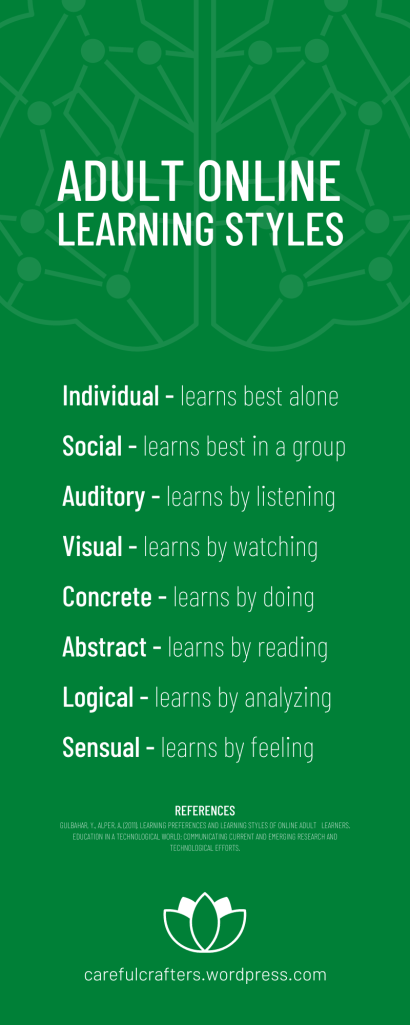
Adult Online Learning Styles Infographic

infographic design of adult online learning styles

I have compiled some short examples of how to use different learning styles in online course design and development. Best practice is to employ all of the styles as it benefits everyone. Do you have a specific learning style that you gravitate to? I would say for me, I use all styles but the one that I use the most would be concrete learning as I am a very hands-on type of person.

  • Individual learning: working individually on a real time project.
  • Social learning: engaging in live workshops and a social media group.
  • Auditory learning: one on one instruction with me, voice overs in video examples.
  • Visual learning: screen grab examples, graphics and embedded videos.
  • Concrete learning: task of writing a blog post, producing a video, creating a graphic.
  • Abstract learning: reading of instructions and additional linked materials.
  • Logical learning: make reference to other similar technology programs.
  • Sensual learning: crafting stories about themselves, reflection of feelings.

References

Gulbahar, Y., Alper, A. (2011). Learning preferences and learning styles of online adult learners. Education in A Technological World: Communicating Current and Emerging Research and Technological Efforts. https://www.researchgate.net/publication/266592841_Learning_Preferences_and_Learning_Styles_of_Online_Adult_Learners