
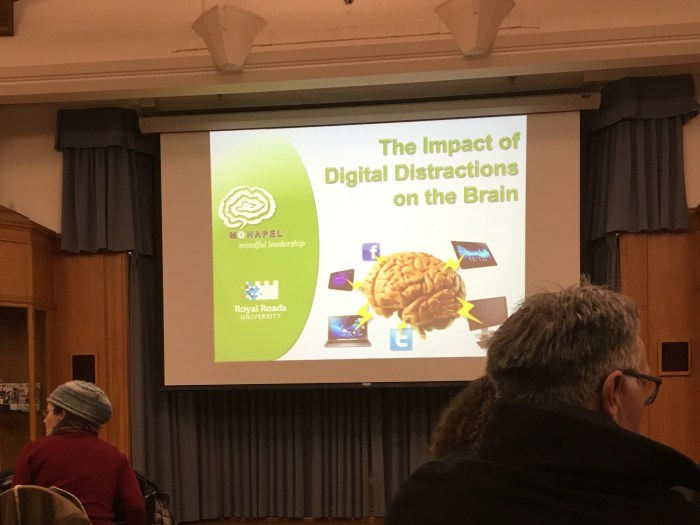
These notes were taken at Royal Roads University’s free talk on digital distractions given by Paul Mohapel, PhD (Psych.) in September of 2019. I transcribed the presentation into a bullet list for easiest reading. There was much more information presented but this is what I jotted down. I highly recommend attending his next seminar if you can access it.
I will be using this information to better steer my own digital usage and content creation. In the end, it comes down to balance but really, there are some major steps to mitigating the damage that digital screens is doing to our brains. I’ve also activated the new screen time feature on my iPhone. We need to become digital use stewards and act as examples.
Implications of Digital Distractions & Multitasking
- We have attention span issues
- Multitasking = problems in brain due to distraction and addiction
- People spend ⅓ less face-to-face time due to social media; this is causing major behaviour issues
- Focus times have decreased from 12 min to 3 min attention span; we’re losing our ability to focus
- Every psychological disease up 20% including emotional disturbances
- People get less done due to digital distraction and multitasking
- People spend 50% more time online than they thought
- 30-40% check phone first upon waking up in bed; looking at screen 1 hour before sleep inhibits melatonin production, replace smartphone alarm for traditional alarm clock instead
- ADT (Attention Deficit Trait) on rise in adults
- High level multitasking is bad for the brain, but demanded of us everywhere
- Multitasking = wasting time, creates a blindspot impairment
- Distraction is the biggest threat to productivity
- Canada has the highest screen time usage, average of 36.7 hours / week (not including work)
- Canada has the most internet usage per capita in the world
- Kids are using screens 2.5h / day global average
- Breastfeeding babies receive less attention from mother who is looking at digital device
- There is a correlation between obesity and screen time usage
- People eat in front of screens (even the fit ones)
- Screens are diminishing social relationships
- Screens impair our thinking
- Screen impact severity ranges from TV being the least to smartphone the most severe
- Reading on paper = recall more information whereas reading on screens = diminished retention
- Hand-eye coordinative activities help heal brain
- We participate in superficial screening and scrolling, meaning the longer the scroll is or digital text is, the more fatigued we become. Paper reading gives our brains the break we need, digital scrolling does not.
- Online activities are rewiring our brains, is severe and profound
- Our brains can’t multitask
- Goal direction is impaired
- Excessive online gaming = results temporary lobotomy of part of the brain
- Multitasking maybe physically shrinking our brains
- Gaming and internet addiction showing similar brain impacts
- Multitasking releases stress hormones of cortisol (I experienced this first hand in 2016 and after that shut my digital practice down to figure out what happened to me), prolonged impact can cause harm to frontal cortex, hippocampus
- Addiction / multitasking consist of three traits: 1. Compulsion 2. Loss of control 3. Negative emotions
- Distracted driving is the #1 cause of death in car accidents
- 1 min use of social media spikes positive sensations, after 5 mins falls down to negative
- Conditions for addictions, check if you experience the following: stimulated multisensory cues, immediate gratification, social reinforcement
- Phones are extremely addictive
- Canadians check phones 150 times a day but only 4 times a day is safe
- Average person checks phone every 15 mins
- 73% feel panic when phone is misplaced
- Online addiction sources in the following order: email, social media, porn, gambling, shopping
- Internet addicts and gamers have thinner brains (muscle loss) and are less functional
- Hands on skill activity increases brain health
- Too much information is a bad thing; Technology drives more information
- Social media is all about more = quantity not quality, in other words social media cares for quantity not values
- We are not having a deep experience through social media
- Focus of attention = more intelligent – risk of loss
- Prefrontal Cortex is at risk
- Doctors in Canada are at 50% burnout due to multitasking
- We don’t know the fullest fallout extent yet
- Seniors are the fasted growing user group
- We are spending less time in our optimal zone and more time in under and over stimulation zone, affects our productivity
- Corporations exploit our addictions to feed us more information technology for $
Mitigating These Impacts
- Containment Strategies
- Set boundaries and limitations – turn off notifications. Use less apps and applications less often.
- Focus – on one thing at a time ‘mono’ task to completion. Limit multiple tasks.
- Technology breaks – check social media / digital device no more than 4 times a day and no longer than 5 mins sessions. Abstain from screens for at least 4 consecutive hours a day – doesn’t include work or sleep. More than that puts us at risk of addiction patterns = brain impairment / shrinkage.
- Sustainment Strategies
- Exercise – 30 mins a day at the min, 20 min nap = full night sleep brain restore.
- Substitutions – books, physical board games, writing, reflection, meditation.
- Mindfulness practice – meditation goes in reverse of distraction, stay present, in the moment, non judgemental, open emotionally, sustained attention. Meditation reverses effects of brain thinness to thickness.
Ex-employees of Silicon Valley started up the Humane Technology Society to help steward digital use impacts. Visit Net Addiction for self-help.