Assessment & Feedback for Online Learning

Online learning assessment and feedback strategies are essential for successful learning outcomes. Assessments fall into three categories: 1. Assessment for learning – such as designing learning outcomes based on student knowledge, 2. Assessment as learning – the stage when students are engaging and active with the learning process and pulling from previous knowledge to build new knowledge and finally 3. Assessment of learning – a summative process that confirms what students have come to know and or do, and where they stand in relation to others by the end of the course.

Instructors and students can measure the learning progress and outcomes by monitoring, surveying and communicating. There are various methods of assessment used for formative (while learning) and summative (concluding) such as performance-based assessment (a real life task), that can overlap both areas. Feedback travels between peers and also between peer and instructor so that both learner and instructor can improve upon the quality of learning. For instance, a survey could capture the learner feedback about their mid way or final feedback in regards to their experience, and where improvements can be made.

Learning Management Systems (LMS) offer a variety of assessment tools such as multiple choice quizzes that are best used when testing static or technical information. LMS support the learners needs to interact with peers in forums, often provides a journal system, and social tools for sharing group and independent feedback. Effective feedback needs to follow principles that are descriptive, focused, limited, timely and peer contributed. Both peer and self assessment are effective factors for learning and are the backbone of a students learning outcomes.

Within the LMS instruction, ensure to incorporate 7 principles of assessment: 1. Support students with various needs, 2. match the learning curriculum and learning goals to match that of the interests and learning styles of all the students, 3. communication of important points are indicated at the start and throughout, 4. provide various types of assessment, 5. provided over time through multiple opportunities to reflect a full range of learning, 6. provide ongoing description feedback that is clear and timely for the means of meeting the final achievement, 7. foster students to self-assess their own learning, goals and next stages of learning (Government of Ontario, 2010).

References

Government of Ontario. (n.d.). Facilitator’s guide  – assessment for learning. http://www.edugains.ca/resourcesDI/D.I.%20Enhancement%20Package/Assessment%20for%20Learning/DI_Assessment_Gde_2009.pdf


The Building Blocks of Online Learning Design & Development

The following are items to be considered when designing and developing an online course for adult learners. Andragogy, founded by Malcolm Knowles, discovered the 5 assumptions of adult learners: self-concept, learner experience, readiness to learn, oriented to learning, motivated to learn. There is a lot that goes into online course development, it is not as simple as assembling information. From an academic perspective, it is a very thorough process that can involve an expert team to fulfill all the demands. I have synthesized a brief overview of what is involved when designing and developing online learning for adults. This is my best practices check list (is subject to change and grow) to ensure that key elements are present while also keeping future clients informed on decision making.

The below items can be blended and augmented however I feel the principles need strong attention. I have compiled this to simplify the academic standards for the outsider who will not know what is involved and why it is used. When choosing to design and develop a course, it’s important to begin with who the learner is and what approach to use – Andragogy (adult) or Pedagogy (child) as the two involve very different approaches. My work centres around adult learning.

animated gif of Andragogy online learning principles, theories and models

Theories – understand the learner

  • Behaviouralist – learning through behavioural patterns by linking stimuli and response
  • Cognitivism – learning is internal and a result of processing and organizing new information
  • Connectivism – learning influenced through digital age technology based on accurately sourcing and accessing of information
  • Constructivist – knowledge is constructed by adapting new information based on previous experience
  • Experiential – learning through life experience, through observation and conceptualization
  • Transformative – learning through change which happens reflectively and holistically

Models – process of development

  • ADDIE – analyze, design, develop, implement, evaluate. A non-linear comprehensive model used by large organizations for company training
  • Backwards Design – setting goals first consisting of 3 stages: identify desired results, determine acceptable evidence, plan learning experiences and instruction. Good for story telling learning contexts and ESL learners
  • SAM – successive approximation model is designed for quick turn around focusing on progress over perfection, has 3 phases: preparation, iterative design, interactive development. Often used for training in IT sectors
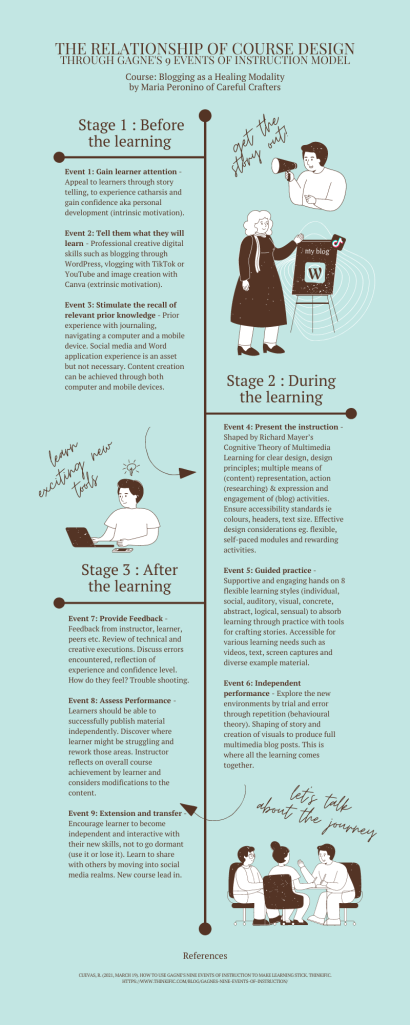
  • 9 Events of Instruction – a linear model that predates the digital age but applies to current learning standards. Can be organized into 3 larger chunks: before, during and after the learning. See example here. Suitable for eclectic learning contexts

Principles – design enriched learning

  • Accessibility – universal design standards, cultural, ESL
  • Adult learning – involvement, experience, relevance, problem-centered
  • Assessment – performance-based, diagnostic, formative, summative
  • Content – chunked, clear, mini-module, flexible, varied media
  • Engagement – peer to content, peer to peer, peer to instructor
  • Learning Styles – individual, social, auditory, visual, concrete, abstract, logical, sensual
  • Motivation – self-directed, independent, intrinsic (personal), extrinsic (professional)

References

Bowen, R. (2017). Understanding by design. Vanderbilt University Center for Teaching. https://cft.vanderbilt.edu/guides-sub-pages/understanding-by-design/#template

Fairbanks, B. ( 2021, September 09). 5 educational learning theories and how to apply them. Phoenix Blog. https://www.phoenix.edu/blog/educational-learning-theories.html

Gore, E. (2022, January 4). The SAM (successive approximation model) approach to eLearning. https://elmlearning.com/blog/sam-successive-approximation-model-approach/

Gulbahar, Y., Alper, A. (2011). Learning preferences and learning styles of online adult learners. Education in A Technological World: Communicating Current and Emerging Research and Technological Efforts. https://www.researchgate.net/publication/266592841_Learning_Preferences_and_Learning_Styles_of_Online_Adult_Learners

Lin, J. (2020, July 5). Quickly implement eLearning from what you have: ADDIE model in practice. eLearning Industry. https://elearningindustry.com/implement-elearning-how-use-addie-instructional-design-model

Loveless, B. (2022, March 29). 15 Learning theories in education (a complete summary). Education Corner. https://www.educationcorner.com/learning-theories-in-education/

Pappas, C. (2013, May 9). The adult learning theory – andragogy – of Malcolm Knowles. eLearning Industry. https://elearningindustry.com/the-adult-learning-theory-andragogy-of-malcolm-knowles

University of Colorado Boulder. (n.d.). Office of the undergraduate education – backward design. https://www.colorado.edu/office-undergraduate-education/backward-design

YouTube Academy & Tips

YouTube Academy is 100% worth the time and energy if you are serious about your YouTube channel. I’m constantly amazed at how YouTube continues to grow into what I think is the most powerful platform on the Internet and it promotes a place of creativity, independence and excitement. There is also a reward in all of this, getting paid. Although getting paid is a huge benefit in running a channel, it shouldn’t be what brought you there to begin with. It starts with your passion and if you’re really tied into it, then the rest will follow. In order to become monetized you need to meet certain criteria first and it’s become harder as of recently. So ultimately it’s really best that you’re driven by your passion and not the money. As YouTube emphasizes over and over in their courses, just keep at it!

My tips for starting out:

  1. Understand your niche(s)
  2. Come up with a branding
  3. Create videos you are passionate about and be yourself
  4. Don’t produce offensive content (stick to community guidelines)
  5. Use proper meta data (titles, keywords, descriptions & thumbnails)
  6. Don’t mislead or spam viewers (including in meta data)
  7. Engage your viewers & ask them to subscribe
  8. Create an upload schedule, let your viewers know about it and stick to it
  9. Understand analytics and utilize it to steer your channel
  10. Use tools such as cards, playlists and sections to group content

Check out YouTube Academy here: https://creatoracademy.youtube.com/page/education

Digital Use Implications

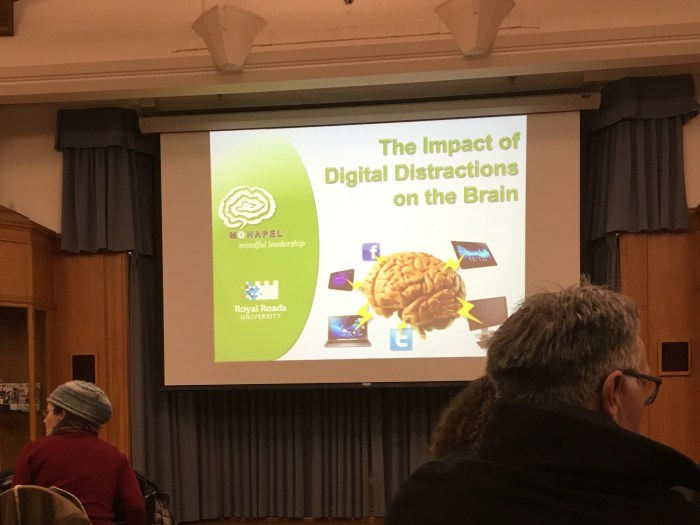
These notes were taken at Royal Roads University’s free talk on digital distractions given by Paul Mohapel, PhD (Psych.) in September of 2019. I transcribed the presentation into a bullet list for easiest reading. There was much more information presented but this is what I jotted down. I highly recommend attending his next seminar if you can access it.

I will be using this information to better steer my own digital usage and content creation. In the end, it comes down to balance but really, there are some major steps to mitigating the damage that digital screens is doing to our brains. I’ve also activated the new screen time feature on my iPhone. We need to become digital use stewards and act as examples.

Implications of Digital Distractions & Multitasking

  • We have attention span issues
  • Multitasking = problems in brain due to distraction and addiction
  • People spend ⅓ less face-to-face time due to social media; this is causing major behaviour issues
  • Focus times have decreased from 12 min to 3 min attention span; we’re losing our ability to focus
  • Every psychological disease up 20% including emotional disturbances
  • People get less done due to digital distraction and multitasking
  • People spend 50% more time online than they thought
  • 30-40% check phone first upon waking up in bed; looking at screen 1 hour before sleep inhibits melatonin production, replace smartphone alarm for traditional alarm clock instead
  • ADT (Attention Deficit Trait) on rise in adults
  • High level multitasking is bad for the brain, but demanded of us everywhere
  • Multitasking = wasting time, creates a blindspot impairment
  • Distraction is the biggest threat to productivity
  • Canada has the highest screen time usage, average of 36.7 hours / week (not including work)
  • Canada has the most internet usage per capita in the world
  • Kids are using screens 2.5h / day global average
  • Breastfeeding babies receive less attention from mother who is looking at digital device
  • There is a correlation between obesity and screen time usage
  • People eat in front of screens (even the fit ones)
  • Screens are diminishing social relationships
  • Screens impair our thinking
  • Screen impact severity ranges from TV being the least to smartphone the most severe
  • Reading on paper = recall more information whereas reading on screens = diminished retention
  • Hand-eye coordinative activities help heal brain
  • We participate in superficial screening and scrolling, meaning the longer the scroll is or digital text is, the more fatigued we become. Paper reading gives our brains the break we need, digital scrolling does not.
  • Online activities are rewiring our brains, is severe and profound
  • Our brains can’t multitask
  • Goal direction is impaired
  • Excessive online gaming = results temporary lobotomy of part of the brain
  • Multitasking maybe physically shrinking our brains
  • Gaming and internet addiction showing similar brain impacts
  • Multitasking releases stress hormones of cortisol (I experienced this first hand in 2016 and after that shut my digital practice down to figure out what happened to me), prolonged impact can cause harm to frontal cortex, hippocampus
  • Addiction / multitasking consist of three traits: 1. Compulsion 2. Loss of control 3. Negative emotions
  • Distracted driving is the #1 cause of death in car accidents
  • 1 min use of social media spikes positive sensations, after 5 mins falls down to negative
  • Conditions for addictions, check if you experience the following: stimulated multisensory cues, immediate gratification, social reinforcement
  • Phones are extremely addictive
  • Canadians check phones 150 times a day but only 4 times a day is safe
  • Average person checks phone every 15 mins
  • 73% feel panic when phone is misplaced
  • Online addiction sources in the following order: email, social media, porn, gambling, shopping
  • Internet addicts and gamers have thinner brains (muscle loss) and are less functional
  • Hands on skill activity increases brain health
  • Too much information is a bad thing; Technology drives more information
  • Social media is all about more = quantity not quality, in other words social media cares for quantity not values
  • We are not having a deep experience through social media
  • Focus of attention = more intelligent – risk of loss
  • Prefrontal Cortex is at risk
  • Doctors in Canada are at 50% burnout due to multitasking
  • We don’t know the fullest fallout extent yet
  • Seniors are the fasted growing user group
  • We are spending less time in our optimal zone and more time in under and over stimulation zone, affects our productivity
  • Corporations exploit our addictions to feed us more information technology for $

Mitigating These Impacts

  1. Containment Strategies
    • Set boundaries and limitations – turn off notifications. Use less apps and applications less often.
    • Focus – on one thing at a time ‘mono’ task to completion. Limit multiple tasks.
    • Technology breaks – check social media / digital device no more than 4 times a day and no longer than 5 mins sessions. Abstain from screens for at least 4 consecutive hours a day – doesn’t include work or sleep. More than that puts us at risk of addiction patterns = brain impairment / shrinkage.
  2. Sustainment Strategies
    • Exercise – 30 mins a day at the min, 20 min nap = full night sleep brain restore.
    • Substitutions – books, physical board games, writing, reflection, meditation.
    • Mindfulness practice – meditation goes in reverse of distraction, stay present, in the moment, non judgemental, open emotionally, sustained attention. Meditation reverses effects of brain thinness to thickness.

Ex-employees of Silicon Valley started up the Humane Technology Society to help steward digital use impacts. Visit Net Addiction for self-help.