
cathARTic explorer

Logo of cathARTic project

I have incepted a new project called cathARTic explorer. This is a combination of nature and creativity to reach catharsis for healing, so the pathway is called ‘cathartic explorer’ via cathartic art. Think of this like being an arctic explorer – both dangerous and thrilling at the same time as that is what it feels like to face an uncharted territory. I have been practicing cathartic arts for years and have finally decided to take it up a notch and to inspire others to do the same. No, I don’t hold a degree in art therapy however it is not necessary to have to experience creative catharsis on your own, nor do I need one to share my ideas with others. I have designed a brochure for this project but it also works as stand alone infographics. Below you will find some videos I composed YouTube. Essentially, my videos are a form of healing art coming from a mindful baseline.

More about my background

In my training I have learned I need to “walk the talk”, I also need to prove it, and I have. I am not coming from a clinical counselling background but rather a designer who has experienced life-long anxiety challenges. So I feel called to share with others, what helps me.

For the creative, technical and delivery aspect of this project, I pull from all of my academic training: BA in Image Arts, MA in Communication and Technology, Certificates in e-Learning and Digital Media. This is combined with my wellness training: Mental Health Ambassador using the REAL-SF framework, Ecotheraputic Guide focusing on indoor and outdoor sources, Healing with the Arts for addressing the self critic, mindful training: MBSR practices for catharsis, and Reflexology for self-applied tension relief. Additionally, I integrate my self-directed studies of Scandinavian cultural history and archeology. I also have drama and theatre arts production training.

I am a peer-to-peer facilitator in what I practice – cathartic art – using mostly digital technology and handcrafting. I do not provide clinical counselling or treat for mental health disorders as that is not my area of training or expertise.

This training exposé is the backbone for my life’s work and proves my learning commitment and capability to you. Living my life with an anxiety disorder, I have found that through nature and creativity comes an incredible form of relief, enjoyment and purpose. I spent my earlier years as an experimental filmmaker whose films about mental health transited the film festival circuit and independent TV (Hot Docs nominee for Neurofeedback about mental health, Victoria Film Festival gift recipient for Breaching about orca captivity, Canada Arts Council for Sea of Souls about animism, as well Images Film Festival, Zed CBC, Knowledge Network, W Network and others). Visit my past portfolio site for more examples. I have returned to these roots to bring you with me into this uncharted territory, you will find your capabilities are limitless.

Who is this for and what to expect

Various types of mediums and outcomes are possible through this pathway and the process will be delivered both in-person and through e-learning. You will have the opportunity to produce your own cathartic stories through nature art, experimental videos, images, cards, and crafts. See my previous post about the Luna Saga for an example of my own story where you will have full exclusive access to that work through a video version, so you can see the outcome of a 20 years in the making cathartic story. Also, completing my masters thesis helped me to resolve my anxiety with a traumatic situation I faced so that I could finally write my Luna Saga. So from my own personal experience, I feel this pathway could be beneficial for those who want to learn how to creatively bolster digital tools to address stress, fear, grief, self-esteem, discrimination, bullying etc but is open to anyone who wants to manage personal / professional well-being. So to recap:

You:

  1. are not to here to seek clinical counselling and diagnosis
    • but requires listening and compassionate guidance
  2. want to explore natural forms of healing
    • through mindfulness and ecotherapy
  3. are seeking to explore creativity with digital tools
    • using a digital device, Canva, TikTok, YouTube and apps
  4. are looking to tell a cathartic story
    • through image, video, card making
  5. want to establish a ritual routine going forward
    • combining nature, creativity and catharsis

You will be trained in the digital medium(s) of your choice through the process, given the support you need to see it through and fun rituals for going forward. To recap my areas of creative expertise are:

Digital and natural mediums:

  1. image capture through digital device & manipulation with apps
  2. producing experimental videos & vlogs for TikTok and YouTube
  3. blogging with WordPress
  4. collage and (story / oracle / tarot) card production with Canva
  5. nature-based handcrafting / Lego building

Outcomes:

  1. identify creative project goals
  2. establish mindful & nature therapy practice
  3. apply creative and digital tool training
  4. produce cathartic art
  5. implement a personal craft ritual

Delivery: 1 to 1 online or in person

Prerequisite: Recommended but not required Wellness in the Digital Age

Required: A digital device

Cost: By donation

Disclaimer: This pathway is intended for adults and is not a diagnosis, treatment or replacement for medical treatment, clinical mental health counselling or art psychotherapy.

Banner photo: Greenland glacier by Maria Peronino ©2023
Visit project development here

Digital Use Implications

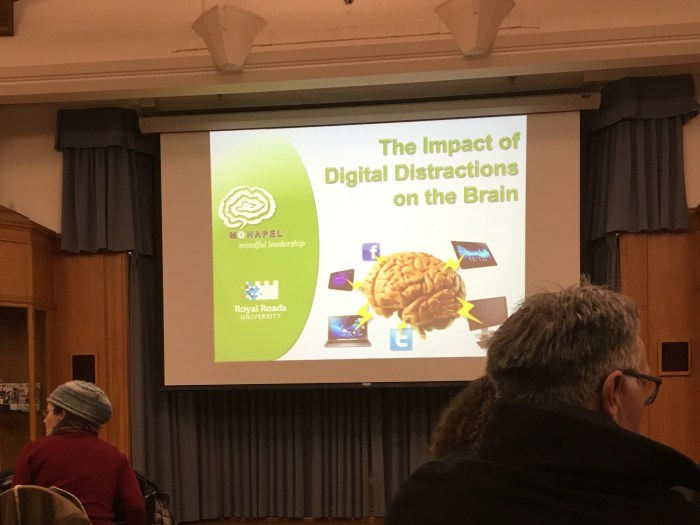
These notes were taken at Royal Roads University’s free talk on digital distractions given by Paul Mohapel, PhD (Psych.) in September of 2019. I transcribed the presentation into a bullet list for easiest reading. There was much more information presented but this is what I jotted down. I highly recommend attending his next seminar if you can access it.

I will be using this information to better steer my own digital usage and content creation. In the end, it comes down to balance but really, there are some major steps to mitigating the damage that digital screens is doing to our brains. I’ve also activated the new screen time feature on my iPhone. We need to become digital use stewards and act as examples.

Implications of Digital Distractions & Multitasking

  • We have attention span issues
  • Multitasking = problems in brain due to distraction and addiction
  • People spend ⅓ less face-to-face time due to social media; this is causing major behaviour issues
  • Focus times have decreased from 12 min to 3 min attention span; we’re losing our ability to focus
  • Every psychological disease up 20% including emotional disturbances
  • People get less done due to digital distraction and multitasking
  • People spend 50% more time online than they thought
  • 30-40% check phone first upon waking up in bed; looking at screen 1 hour before sleep inhibits melatonin production, replace smartphone alarm for traditional alarm clock instead
  • ADT (Attention Deficit Trait) on rise in adults
  • High level multitasking is bad for the brain, but demanded of us everywhere
  • Multitasking = wasting time, creates a blindspot impairment
  • Distraction is the biggest threat to productivity
  • Canada has the highest screen time usage, average of 36.7 hours / week (not including work)
  • Canada has the most internet usage per capita in the world
  • Kids are using screens 2.5h / day global average
  • Breastfeeding babies receive less attention from mother who is looking at digital device
  • There is a correlation between obesity and screen time usage
  • People eat in front of screens (even the fit ones)
  • Screens are diminishing social relationships
  • Screens impair our thinking
  • Screen impact severity ranges from TV being the least to smartphone the most severe
  • Reading on paper = recall more information whereas reading on screens = diminished retention
  • Hand-eye coordinative activities help heal brain
  • We participate in superficial screening and scrolling, meaning the longer the scroll is or digital text is, the more fatigued we become. Paper reading gives our brains the break we need, digital scrolling does not.
  • Online activities are rewiring our brains, is severe and profound
  • Our brains can’t multitask
  • Goal direction is impaired
  • Excessive online gaming = results temporary lobotomy of part of the brain
  • Multitasking maybe physically shrinking our brains
  • Gaming and internet addiction showing similar brain impacts
  • Multitasking releases stress hormones of cortisol (I experienced this first hand in 2016 and after that shut my digital practice down to figure out what happened to me), prolonged impact can cause harm to frontal cortex, hippocampus
  • Addiction / multitasking consist of three traits: 1. Compulsion 2. Loss of control 3. Negative emotions
  • Distracted driving is the #1 cause of death in car accidents
  • 1 min use of social media spikes positive sensations, after 5 mins falls down to negative
  • Conditions for addictions, check if you experience the following: stimulated multisensory cues, immediate gratification, social reinforcement
  • Phones are extremely addictive
  • Canadians check phones 150 times a day but only 4 times a day is safe
  • Average person checks phone every 15 mins
  • 73% feel panic when phone is misplaced
  • Online addiction sources in the following order: email, social media, porn, gambling, shopping
  • Internet addicts and gamers have thinner brains (muscle loss) and are less functional
  • Hands on skill activity increases brain health
  • Too much information is a bad thing; Technology drives more information
  • Social media is all about more = quantity not quality, in other words social media cares for quantity not values
  • We are not having a deep experience through social media
  • Focus of attention = more intelligent – risk of loss
  • Prefrontal Cortex is at risk
  • Doctors in Canada are at 50% burnout due to multitasking
  • We don’t know the fullest fallout extent yet
  • Seniors are the fasted growing user group
  • We are spending less time in our optimal zone and more time in under and over stimulation zone, affects our productivity
  • Corporations exploit our addictions to feed us more information technology for $

Mitigating These Impacts

  1. Containment Strategies
    • Set boundaries and limitations – turn off notifications. Use less apps and applications less often.
    • Focus – on one thing at a time ‘mono’ task to completion. Limit multiple tasks.
    • Technology breaks – check social media / digital device no more than 4 times a day and no longer than 5 mins sessions. Abstain from screens for at least 4 consecutive hours a day – doesn’t include work or sleep. More than that puts us at risk of addiction patterns = brain impairment / shrinkage.
  2. Sustainment Strategies
    • Exercise – 30 mins a day at the min, 20 min nap = full night sleep brain restore.
    • Substitutions – books, physical board games, writing, reflection, meditation.
    • Mindfulness practice – meditation goes in reverse of distraction, stay present, in the moment, non judgemental, open emotionally, sustained attention. Meditation reverses effects of brain thinness to thickness.

Ex-employees of Silicon Valley started up the Humane Technology Society to help steward digital use impacts. Visit Net Addiction for self-help.