I’ve started a Lego Blog!

It’s been a while since my last post. I’ve also been on and off traveling pretty consistently over the past year 2 years and so it’s easy for me to disappear for a while. Last year, I started making Lego content for my YouTube channel. The Lego content is often based on the ASMR style for the purpose of providing calming to the viewer. On the about page, I explain a little bit about the endeavour.

This year I completed Google’s Marketing and E-commerce certificate to help me elevate some of my projects. While some of that learning was well over my head, it was clear that I needed to focus on improving my marketing approach – it’s not something I have ever sat down and studied properly. As a result, I have upgraded my handcraft website with a stronger background story. For my YouTube channel, I followed the learning advice and built a blog that I could share to other social channels, to help get my content noticed more. Of course this also helps the search engines to discover my content as well. On that note, here’s a reminder to pay attention to labelling images with proper titles and descriptions since images can’t be read by a search engine otherwise. By embedding the original video in the blog post, the additional views are added to the source video. I have found YouTube can be disappointing at times, when it comes to getting content viewed. If you’re interested in Lego content creation, please subscribe to Build With Bo and my Curious Bo YouTube channel. Also, check out my improved Bo Handcraft website – featuring a blog with interesting and related content. Below is a crosspost of my latest Lego blog post.

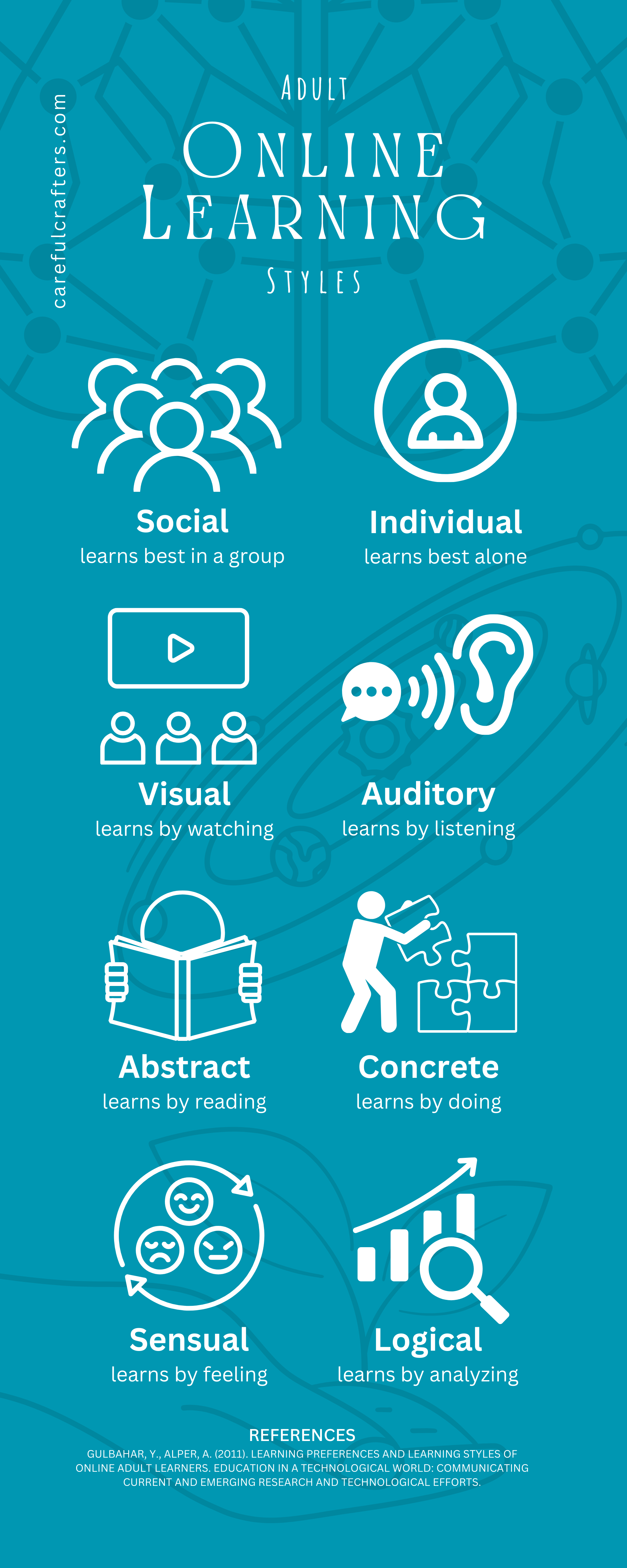
Online Learning Styles Infographic

Next time you set out on a learning endeavour, think about the ways in which you learn best. We all have learning styles that we prefer over others. Although I learn through all styles, my strongest learning happens while doing. Do you have one learning style that you have recognized to be stronger than the others?

I have revamped a previous infographic to match the design and style of the new ones, and this time I also added visuals.

Infographic of online learning styles

Autism Challenges Infographic

I will continue to design a variety of infographics that align with the themes and values of Careful Crafters. They will all carry a similar style as the last two, each with a different colour.

I decided to put together a simplified version of some of the challenges I face with being (diagnosed) neurodivergent and likely autistic. Although there are many more challenges, these are the ones that seem to be the most prevalent for me on a daily basis, and why I “don’t work” in the work sector like others do. Explaining my experience to people, has also been challenging and so sometimes it’s just easier to give them something to look at. I am also doing this to remove any stigma that comes with autism; I am not incapable, I just operate differently than other people. While this infographic looks at the challenges, I will produce another that looks at some of the qualities that comes with autism. I hope that by producing this infographic to communicate on behalf of my own challenges, that it also helps someone else. For more read my blog post: Learning with an Invisible Disability

Online Learning Tips Infographic

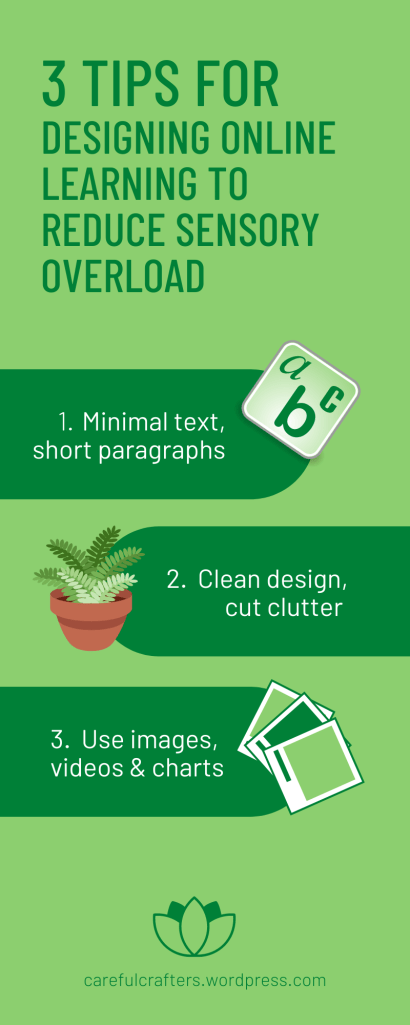
As obvious as this may seem, it’s amazing how online learning material can still be so overwhelming. I created this very basic and simplistic infographic to drive the point home. As someone who experiences jumping text and eye rolling due to over stimulation through screen reading, I felt it was necessary to point this out. It’s generally a good idea to include a variety of learning mediums so that you can reach the different learning styles – as we all learn differently. Stay tuned for a post on the various learning styles.

infographic of tips for designing for sensory overload

Assessment & Feedback for Online Learning

Online learning assessment and feedback strategies are essential for successful learning outcomes. Assessments fall into three categories: 1. Assessment for learning – such as designing learning outcomes based on student knowledge, 2. Assessment as learning – the stage when students are engaging and active with the learning process and pulling from previous knowledge to build new knowledge and finally 3. Assessment of learning – a summative process that confirms what students have come to know and or do, and where they stand in relation to others by the end of the course.

Instructors and students can measure the learning progress and outcomes by monitoring, surveying and communicating. There are various methods of assessment used for formative (while learning) and summative (concluding) such as performance-based assessment (a real life task), that can overlap both areas. Feedback travels between peers and also between peer and instructor so that both learner and instructor can improve upon the quality of learning. For instance, a survey could capture the learner feedback about their mid way or final feedback in regards to their experience, and where improvements can be made.

Learning Management Systems (LMS) offer a variety of assessment tools such as multiple choice quizzes that are best used when testing static or technical information. LMS support the learners needs to interact with peers in forums, often provides a journal system, and social tools for sharing group and independent feedback. Effective feedback needs to follow principles that are descriptive, focused, limited, timely and peer contributed. Both peer and self assessment are effective factors for learning and are the backbone of a students learning outcomes.

Within the LMS instruction, ensure to incorporate 7 principles of assessment: 1. Support students with various needs, 2. match the learning curriculum and learning goals to match that of the interests and learning styles of all the students, 3. communication of important points are indicated at the start and throughout, 4. provide various types of assessment, 5. provided over time through multiple opportunities to reflect a full range of learning, 6. provide ongoing description feedback that is clear and timely for the means of meeting the final achievement, 7. foster students to self-assess their own learning, goals and next stages of learning (Government of Ontario, 2010).

References

Government of Ontario. (n.d.). Facilitator’s guide  – assessment for learning. http://www.edugains.ca/resourcesDI/D.I.%20Enhancement%20Package/Assessment%20for%20Learning/DI_Assessment_Gde_2009.pdf